Showing posts with label Learning. Show all posts

Sunday, 18 July 2021

The Big Butterfly Count 2021

It is that time of year again where the Butterfly Conservation Organisation are asking us to take part in the  annual Big Butterfly Count 2021!  This is a great activity to do over summer and will be especially useful this year as lots of us will be staying at home in the UK or perhaps travelling to different parts of the country too. You can collect data from wherever you are!  And the more data we collect, the more we can understand about how butterflies are doing in the UK and how we can help them.

Butterflies are a good indicator of the health of our environment.  The more species of butterfly we see, the healthier it means our environment is and the more varieties of plants and insects there are about.  There are thought to be around 60 types of common butterfly in the UK.  However, the numbers of butterflies and moths being recorded has significantly decreased since the 1970s due to land use change and habitat loss.  With the threat of climate change worsening and more extreme weather in the future, the outlook for butterflies does not look good.

The Butterfly Conservation Organisation therefore want us to help them survey butterflies in the UK and record where and when we are seeing them!  Visit their website https://bigbutterflycount.butterfly-conservation.org/about or download their app 'Big Butterfly Count' for more information on what to do.  The count lasts from 16 July until 8 August 2021.  Set aside 15 minutes to do a butterfly count (you can do more than one, perhaps even one every day!) and record your results on the app or website.  Even if you don't see any butterflies, you can still record it as this is useful information too.  The app also has a handy ID page to help you identify which butterflies you are seeing.  

Happy butterfly hunting!

Saturday, 22 May 2021

For the love of bees

The celebration of World Bee Day this week drew attention to the plight of the world's bees and how our behaviours are contributing to their decline 🐝

Bees are some of our most important pollinators and they do a huge amount to ensure the diversity of our ecosystems.  We rely on them for the survival of our food crops most of which are pollinated by wild insects rather than by human intervention. Without them, this would cost us £1.8 billion to achieve!  Some bees provide us with other luxuries such as honey. These bees are often kept in hives but also contribute to the pollination of farm crops.  

Sadly, bee populations are now in decline. This is due to five main causes:
❌ Habitat loss - replacing natural areas with intense farming land or urban developments deprives bees of the wildflowers and meadows that they usually thrive on
❌ Climate change - changes in weather patterns are affecting the times that flowers bloom and bees are struggling to adapt to these changes meaning that they miss out on important food sources
❌ Pesticides - these are harmful to bees and often either kill them or prevent them from reproducing 
❌ Pests -  honeybees can be particularly susceptible to pests and disease which can spread through their hove colony; beekeepers should make sure they check on the health of their hives to stop diseases spreading to other populations
❌ Invasive species - some non-native bee species pose a threat to the survival of UK bees and so these species need to be kept an eye on to ensure their numbers don't become threatening

So what can you do to help?
🐝 Get planting!  Even in you just have a windowsill or window box, get some wildflower seeds and create a little pollen pit-stop for bees to refuel on as they fly past
🐝 Let the grass grow! Try not mowing your lawn or at least leave part of it unmowed for bees to feed and shelter in 
🐝 Leave off the pesticide! Pesticides do so much harm and there are easy alternatives such as using diluted washing up liquid water to remove aphids
🐝 Plant through the seasons! If you have a garden, try to include a range of plants that will flower and seed through spring, summer and autumn to give bees the best chance of survival

For more ideas, visit Friends of the Earth at friendsoftheearth.uk/nature/10-easy-ways-help-bees for some more tips and ideas 🐝

Sunday, 16 May 2021

Walk to School 2021

This week is Walk to School week! 👣

The five-day challenge will take place from 17th-21st May and will encourage everyone to get to school by walking, cycling, scooting, parking & striding.... anything to get people travelling in a clean and sustainable way that will benefit our planet and local community.

Every school day, the school run adds a huge volume of traffic to our roads in the mornings and afternoons.  This puts large volumes of carbon emissions into the atmosphere which contributes to climate change.  It also impacts on the air quality in our local area which can have a negative effect on the health of children who are trying to walk or cycle to school and end up breathing in the fumes. 

Making the effort to walk or cycle into school this week will help to challenge and reframe our perception that it's easier to drive everywhere or that it's just too much hassle to walk.  Walking has so many benefits and not just to your physical health; it has been shown to improve concentration, boost creativity, and give people a better connection to their environment and nature.  You notice more when you're walking and it's fantastic to see the changes in your local area from one season to another. 

I've been trying to walk to school at least once a week (usually on a Friday) and to be honest, I really look forward to listening to a podcast on the walk in, and then taking a slightly longer more scenic route back home at the end of the day.  It really helps me to unwind at the end of the week, and it signals that it's the weekend and that I'm ready to relax and recover from a hectic week.  It's also shown me that it's not really that hard to walk in each day... and I can easily still do any errands on the way which I don't really need a car for.  And it saves money on petrol too!

Living Streets has a fantastic website with lots of information and ideas about how to help your school have a successful Walk to School week. Visit them here at www.livingstreets.org.uk 👣

Sunday, 2 May 2021

Protecting our coasts

The UK has around 18,000km of coastline which includes all kinds of valuable ecosystems from rockpools to sand dunes to estuaries.  Many of us will have been lucky enough to visit the coast on school holidays and some of us will even have the privilege of living with a beautiful beach or coastal stretch right on their doorstep.  Being an island, you are never more than 70 miles from the sea in Britain and our coastlines are beautiful landscapes that we need to appreciate and protect.  

Lots of UK beaches have Blue Flag Awards which means they have met the criteria for water quality, environmental management and safety.  This is fantastic as it means they are clean and safe to visit with our children and pets, and can support wildlife that thrive in their ecosystems.  However, our beaches are still subject to littering, whether that be from visitors, tourists or wild campers, or washed up by the sea itself.  Microplastics are a real problem as they are invisible and cannot simply be picked up out of the environment.  

The recent documentary 'Seaspiracy' highlighted the impact of the fishing industries on our seas, oceans and coastlines.  It claims that the majority of plastic waste in the oceans comes from fishing nets and that a huge amount of damage and devastation is carried out by trawler fishing.  When we buy and eat fish, we contribute to this industry and this in turn may have an impact on the biodiversity in our seas and the quality of our coastlines both at home and abroad.

We can take some simple steps to protect coastlines everywhere.  Making efforts to clean up the beach or change behaviours that prevent beaches from getting polluted or degraded are both equally effective.
🐬 Take part in a beach clean up - get a community group or a school group to do a litter pick along a stretch of coastline; this not only actively cleans the beach but it helps educate and raise awareness of how polluted our beaches can get 
🐬 Stop buying plastic items - we know this already but it's so hard to fully commit to; make one swap this week that will save  some more plastic
🐬 Wash your clothes with ecofriendly detergent - our waterways have a lot of chemicals in them from both households and industry; try a different detergent that us gentler on the microorganisms that live in the water
🐬 Reduce your fish intake - eating less fish will reduce demand over time; this will allow fish populations to grow back and reestablish natural balance
🐬 Visit the coast - if you don't live near the coast, take a trip there or plan a visit with your local school; there is no alternative for actually visiting a place to help bring about an appreciation and understanding of it

If you live near the coast, why not develop a Beach School either alongside or instead of a Forest School!  Any learning in the outdoors is so important and all environments have something valuable to teach us. Click here to find out more. 

Sunday, 25 April 2021

The power of worms

If you're looking for something new to add to your forest school or outdoor learning area, then consider building a wormery!  They may not sound like the most appealing of structures to have, but they can be absolutely brilliant for teaching about the importance of soil and the processes that happen within it.  If you happen to be on a school site, you can add some of your school's food waste to it as well which helps reduce the amount of food that goes to landfill.  Having a wormery provides a great teaching point and can really help educate children on what happens within soil and how decomposers are some of the most important organisms in the ecosystem.  

You can make a simple wormery that will last for about a week (visit the Wildlife Trusts website to find out more).  All you'll need is a large (1 litre) plastic bottle with the top cut off.  Build up several layers of garden soil, compost and sand, and top with some fallen leaves or old flowers.  Then, hunt down some worms and add them onto the top layer of the wormery.  The'll soon bury down and start decomposing all the decaying matter.  Secure the top with some cling film and an elastic band - don't forget to puncture some holes in the cling film! Wrap the bottle in some card to make it dark for the worms and place it in a cool part of your outdoor space.  Check the layers every so often to see how the worms are doing, and add a little water as necessary to stop it drying out.  Finally, when you have finished with your wormery, release the worms back into the wild so they can continue doing their important work under our feet!

To make it a more permanent structure, buy a wormery which comes with multiple trays and layers for the worms to work their way through. This acts similar to a compost bin but has the added excitement of seeing the worms doing their thing.  How much of the school's food waste can you fit in the wormery?!

Thursday, 22 April 2021

Earth Day 2021

Today we have been celebrating Earth Day and it has given us a chance to stop for a moment and think about the impact we are having on earth, our common home.

We have had lots of good conversations in school today about what we do that harms our planet, and how we might go about changing those behaviours.  I have been so impressed with the ideas that children have had in school, and I think it just highlights the importance of making green choices every day and the significant impact this can have over time.

Schools are great places to start when trying to make big social change.  If we instil those green values in young people, then they are more likely to go on and make sustainable choices later in life.  They can also influence people around them and other communities outside of their school life.

For the last year or so, I have been exploring ways of making schools greener places to teach and learn.  Many of the actions we can take are ones we know already; turn lights off when you leave the room, recycle paper, bring a reusable water bottle, eat all your food at lunchtime etc.  However, these changes alone are not always enough to bring about significant change.  They are also difficult to remember to do in the hectic nature of a busy school day.  I'd like to offer a few different ideas that might help to make a difference over time.  Some of them might require more effort or time but I guarantee they'll make a difference (and might save some money too!) Let's see how many you might manage to do?! 

🌍 Exercise books are a huge cost and use of paper -> swap them for slim, cardboard files or folders - this will save paper and glue as you won't need to glue worksheets in all the time; it should also save you a good amount of money, and time as you won't have to trim worksheets down to fit into books
🌍 Food waste can be a big problem in schools -> involve children in deciding on the school menu - this will give them to opportunity to express a preference which will lead to less food waste; make sure you buy local and seasonal as well
🌍 Schools can be very harsh environments -> bring plants into the school and classroom - green has a calming effect on the mind and the plants will help to purify the air; you can make it a task or responsibility for children to have to look after them and water them on a regular basis
🌍 Lots of water goes down the drain every day -> install some rainwater harvesters around your school grounds - the water can be used for watering plants, topping up a bird bath, or creating a mini pond; develop a little outdoor space or forest school area in which to do outdoor learning
🌍 Uniforms are often bought new or thrown out after use -> create a system where uniforms can be passed down or bought second hand to save them going to landfill; it will save parents money too, and you should encourage children to care for their clothes and belongings and not treat them as disposable or replaceable items

It is also a great idea to create an eco-council or green club within your school so that children can take ownership of what happens and change comes from within.  Sign up to become an EcoSchool with eco-schools.org.uk and follow their steps to becoming a sustainable school community.

🌍  Happy Earth Day!  🌍

Sunday, 18 April 2021

Saving water

You might have noticed that it hasn't really rained much over these past few weeks.  Plants in the garden are looking a little drier than normal, and buds and leaves are seeming slow to burst and blossom due to the cold dry air that has been lingering for some time.  I've been out in my outdoor spaces trying to get things ready for early summer and get some seeds sown, but it hasn't escaped my attention that the soil is looking dry and cracked and in need of a good rain shower.

What we can do when nature needs a bit of a helping hand?  Turning the hose on and giving the garden a good old water is an obvious choice, but if water levels are low overall then we run the risk of depleting supplies even further.  Water demands are only getting higher with all the appliances that we run daily that use lots of water, and climate change is causing the supply of water available to decline. So what can we do?

Water conservation is the key and there are a number of actions we can take.  Year-round rainwater harvesting is a good option as it makes use of the natural abundance of water from the sky.  It is also a better choice than tap water as it doesn't contain chlorine and other chemicals that may exist in treated water.  You can also channel water from gutters and pipes that would otherwise go down the drain. Buy a water butt to store your water in and use a watering can to carry the water to the plants that need it.  

Grey water is water that has been used for washing and cleaning.  This water can also be used for watering plants though it's best to use it straight away rather than storing it.  Soil and compost can usually filter out any mild residue of soap and detergent.  Make sure you use this water on general plants and not ones that are going to be eaten.  

Finally, if water supplies are low then chances are that birds, insects and other wildlife are also struggling for a drink.  Consider putting a bird bath in your garden for birds to drink from or wash in.  Building a mini pond or even putting a large washing up bowl of water in your garden somewhere can also act as a vital drinking source.  Keep an eye on it and make sure it stays topped up as temperatures continue to rise and rainfall levels stay low.

For more information, visit the RHS website to find out how to save and store water.
The Wildlife Trusts website has some good information on how to build a pond.

Monday, 12 April 2021

Activity: Planting sunflowers

Sunflowers are an easy plant to grow and very rewarding when you see how tall they've become!  In a few simple steps, you can get your own sunflower plants off to a great start and you can even do it using sustainable, plastic-free resources.

First, you need to get hold of some sunflowers seeds.  April and May is the best time to start to grow sunflowers.  You can easily find seeds in garden centres at this time, or sometimes supermarkets and hardware shops (my local ironmongers has loads of cheap seeds that are easy to grow!) If you know someone who has previously grown sunflowers, you could ask them if they have any spare seeds from the previous year.

To help the seeds germinate, place them in some damp kitchen roll and place on a warm window-sill for a couple of days.  This isn't essential but might just help them get started before putting them into the soil. 

You can then sow your seeds straight into the ground, or you might like to start them off in some small containers such as yoghurt pots or tin cans.  All you need is some fresh soil or compost and a trowel or spoon to dig the soil.  Place the seeds in about 1cm down and cover them over.  Make sure you give them a good initial watering.  

As the seeds start to grow you might want to thin them out (move then a bit further away from each other) to give them maximum space and light to grow.  Slugs and snails love to eat the new shoots so you can protect them by cutting the top off an old plastic drinks bottle and place it over your new shoots.  

As your sunflower gets taller, support it with a cane or secure it to a nearby fence so it can reach even higher.  If you like, you can feed it with tomato feed which you can buy from a garden centre.  

Finally, once your sunflower has bloomed and faded, harvest the seeds for next year so you can grow more sunflowers without having to buy more seeds 🌻

Sunday, 14 March 2021

Friluftsliv

If anyone's good at embracing the outdoors, it's the Scandinavians. "Det finnes ikke dårlig vær, bare dårlig klær!" - "There's no bad weather, only bad clothes!" There's a lot to be said for this approach, and (aside from cases of extreme weather!) encouraging children to play outside every day and develop resilience is an important life skill.

Friluftsliv is another Nordic word/concept/expression which we can learn a lot from.  Literally translated, it means 'open-air living'.  This means getting outside everyday no matter the season, weather or what mood you're in.  This is generally a part of Nordic culture where there is an emphasis on spending time in nature and being close to greenery, forests and water.  Historically, this may have meant spending extended periods of time in the great outdoors, but nowadays it can mean spending a part of every working day or school day outside, either as part of or in addition to the normal outdoor recreation time.  

In Norway, Friluftsliv is included into the school curriculum.  This means that all children will be taught in an outdoor setting and will learn the skills needed to have adventures and stay safe when outside; this includes skills such as swimming, orienteering, building a shelter, foraging safely for food, using tools, and practising simple first aid techniques.  Some of the teachings come from the Sami people (who are indigenous to Scandinavia) and their traditions, which helps children to understand their culture and develop in a more rounded way.  This approach has been shown to improve social, emotional, physical and cognitive development in children and teenagers. 

The English curriculum includes some outdoors education but this is generally in the context of sport rather than learning about the outdoors. Forest Schools are becoming increasingly prevalent but this is mainly in the primary school setting.  Why not think about adopting some of the ethos of friluftsliv and include it in your curriculum?  What benefits could it bring to both the children and staff at your school?

Sunday, 7 March 2021

Take learning outside this spring

The return to school tomorrow is feeling like a new start for many of us :)  The long winter slog is almost over, and the longer, lighter days are bringing us sunshine, new hope, and the chance to rekindle old friendships.  Why not take the opportunity to introduce some new ideas into your teaching too?

Taking learning outside has been shown to increase engagement and stimulate many more senses and types of learning than in the classroom.  Being outdoors facilitates more practical, hands on learning and encourages children to thrive who might normally shy away from participation in an indoor setting. 

Forest Schools have become a way of making outdoor learning more regular and this helps children to engage with nature and appreciate its dynamics and rhythms over the seasons.  You don't have to be an official forest school, however, to take advantage of the benefits of teaching outside.  Why not incorporate some outdoor time into your science or geography lessons, or even think of a way of taking maths outside or spending time having discussions during a PSHE session?  

Spending time outside may be a particularly useful way of easing the return to school for some children who may find the intensity and chaotic, noisy nature of being in the classroom a bit overwhelming at first.  Including some activities such as forest school crafts or team building games which can be done in an open space might help children interact with each other and remember how to play together.  

There are loads of useful websites for outdoor learning, these are some of my favourites:


Have a search on Pinterest for tonnes of ideas, or look at the resources on my blog too:  learningthroughnatureblog.blogspot.com

Sunday, 28 February 2021

Planting blossom trees

We are approaching blossom season! 🌸🌸🌸

To boost the amount of blossom trees in the UK, the National Trust is pledging to plant hundreds of blossom trees at different sites including London, Nottingham, Newcastle and Plymouth.  These will include varieties such as cherry, hazel and plum which all give beautiful pink flowers in the spring.  The project is hoping to boost nature in these areas where there is currently not much access to green space and to give people a closer connection to the natural world. 

The inspiration for this has come from Japan where each spring they have "Hanami" - the celebration of flowers at the arrival of spring.  Trees are in bloom everywhere you look and it creates quite a spectacle which people travel from far and wide to see.  By boosting the number of trees (particularly blossoming trees) it is hoped that it will create a similar spectacle in the UK and draw people's attention to the beauty of nature.  Many populations live in 'grey deserts' in the UK where there are large areas of no trees or green space, and this can have an impact on people's mental health, and their appreciation and respect for the natural world.  

Blossom is also plays an important in supporting ecosystems.  An abundance of pollen increases the number of pollinating insects such as bees, wasps, beetles and flies.  These in turn feed birds in the local area who can further spread pollen and seeds.  When looked at together, these behaviours all help to make a richer environment that can support a more diverse wealth of wildlife.  

Why not think about planting some blossoming trees in your garden or school?  The sight of blossoming trees can spark interest in young children and help them to understand the life cycle of trees and the seasons. You could even incorporate these events in to lessons, and do some research into places like Japan who have amazing blossom events every year!

To find out more, visit the BBC to learn about the blossom planting project; or kiddle to find out more about Japan's seasonal blossoming 🌸🌸🌸

Sunday, 14 February 2021

The meaning of roses

There are an abundance of roses in the shops at the moment in readiness for Valentines Day, but since when were roses a symbol for love and why are roses important?

Here are some rose facts for you:
🌹There are hundreds of different types of roses including ones that grow in bushes, on the ground, or climbing walls and fences
🌹Roses come in many different colours including red, white, pink, coral, white and peach, each one with a different meaning
🌹Roses are known for their gentle floral scent and have long been included in perfumes and confectionery 
🌹Roses are one of the oldest flowers and fossils of roses have been found from 35 million years ago
🌹Flowers have long been given as a gift to show love, and roses are particularly linked to Venus/Aphrodite who was the goddess of love in Roman/Greek times

Roses are a beautiful flower to have in the garden at any time of year and there are so many different types to choose from.  They are known for enhancing biodiversity and insects thrive on the pollen they produce.  Rose hips provide an important source of food for birds in autumn and winter, and rose bushes can make an ideal nesting place for birds and give shelter to smaller mammals. 

If you want to grow a rose in your garden, visit a rose specialist or ask someone for advice in a local garden centre.  The type of rose that may grow best may depend on your garden and how much shade or sunlight it will have.  Roses are fairly hardy plants though and with the right care and attention to pruning, they will be sure to give you an abundance of flowers all summer long 🌹

To find out more, visit the RHS's guide to growing roses.

Saturday, 9 January 2021

A Happy Green New Year :)

I think many of us hoped that as the clock struck midnight on the 1st January that things might start to change for the better.  Whilst I know that will be the case (eventually!), I think right now our reality is still a little distant from what we had hoped for.  

Environmental awareness seems a little lower on the agenda than it was before, but my hope is that environmental issues will not be forgotten after lockdown, and that people will become even more passionate about protecting their local green spaces and will strive to make the most of the nature that is always around them. 

If anything, lockdown is teaching us to get outside and appreciate the local wildlife on our doorsteps!  I have definitely noticed an increase in the number of people walking and biking when I go out for my walks and runs, and the little changes between seasons become even more precious and beautiful when you tune in so often to the world around you. 

Schools are having a particularly difficult time at the moment.  As someone who currently works in primary education teaching SEN children, I know the challenge of keeping the sense of school community and normality going for these young people.  However, for me I also see it as an amazing opportunity to get children excited and exploring their gardens, parks, school grounds... wherever they can get to!  Taking the time to get outside (which is definitely more germ-friendly anyway!) and learning about the world is so important and this period of time is a great opportunity to get kids involved in exploring outdoor spaces and beginning projects such as planting bulbs or making bird feeders for the winter. 

This new year, I'll be taking a bit more time to post about how to encourage green education and make your school green too, as I believe that our actions and behaviours have as much impact as any school lesson, if not more so!

Stay tuned for more #learningthroughnature this spring 🌳🌸📝

Saturday, 14 November 2020

Snowberries

Earlier I spotted the arrival of berries on my snowberry plant ❄️

They are even more obvious now that the leaves have faded and dropped away. I don’t know that much about snowberry plants so I had a quick search for some facts and this is what I found:

⚪️  Snowberries are part of the honeysuckle family
⚪️  They are particularly hardy and survive well in areas of poor soil
⚪️  The berries make an important food source for small mammals during the winter
⚪️  Snowberries are toxic to humans and should not be eaten
⚪️  Native Americans used snowberries for medicine and soap, and in Russia they are crushed into dry hands as a kind of lotion

Snowberry is a great choice of plant for your garden as it needs very little maintenance and is a great source of pollen in the summer for bees and provides shelter for animals all year round too.  The only thing you will need to do is make sure you cut it back every so often so that it doesn't take over the garden!

To find out more, click here to read more about the snowberry. 

Sunday, 8 November 2020

What happens to all the leaves?

It has been a beautiful autumn but it sadly feels like its now coming to an end. The days are getting ever shorter and the last of the leaves are starting to fall off the trees. All the woodlands in my local area are carpeted with a layer of rich leaf litter, but what happens to all these leaves over time?

Leaf drop is a very important part of the seasonal cycle in this part of the norther hemisphere, and especially important for deciduous trees.  When leaves fall to the ground, they slowly begin to decompose and decay.  This is when the leaf breaks down and goes back to its original components such as sugars, fibres, and nutrients.  The main decomposers are creepy crawlies such as woodlice, slugs, snails, worms and bacteria.  A further major decomposer of leaves is fungi or mushrooms!  You see these a lot in woodlands and forests and there are literally hundreds of different types!

Although we don't like to think too much about rotting leaves and slimy slugs, this is actually a hugely important process and our woodlands wouldn't survive without it.  The process of decomposing releases nutrients back into the soil and these can then be taken up by the plants and trees again in the spring, ready to grow new leaves, buds and blossom.  

It is wonderful seeing all the fallen leaves on the ground in our local parks and wooded areas; however, there is sometimes the temptation to get rid of the leaves that we have in our back gardens and yards to make them look neater and prettier.  Maybe this year, think about leaving some of the leaf litter on the ground or putting them into a compost bin where they can continue rotting down naturally and then add the goodness back into the soil. They won't do any harm lying on the ground, and they may even boost your garden's richness and biodiversity next year!

Click here to read more about the Wildlife Trusts' 'Leave a Wild Corner' campaign.

Tuesday, 3 November 2020

A bumper year for nuts and seeds

This year has seen a bumper crop of nuts and seeds from our favourite woodland trees.  This is known as a mast year... but why does it happen? 🌰🌰🌰

Every few years, trees can decide to produce a huge number of nuts and seeds and drop them all on the ground at the same time.  This means that there is more than plenty for all the birds, mice and squirrels to feed on and there are probably quite a few seeds that get left uneaten.  These seeds then go into the ground and lie dormant over winter.  In the spring, they germinate and grow up a little saplings that in the future will make their own nuts and seeds!  

You might think that the trees would do this more often as it sounds like a good way to ensure that lots of seeds get sown leading to more trees growing.  However, it takes a lot of energy from the trees to grow so many nuts and seeds and it actually stunts their growth when they do this.  Therefore, trees only have a mast year every 5-10 years so that they can continue to grow tall. 

The other mystery is how the trees know to do this all at the same time!  It wouldn't really work if only one tree dropped it nuts and seeds as they would probably all get eaten.  Scientists reckon that trees have a clever way of communicating through the soil, and that the weather also has something to do with helping the trees time their bumper crop.  

To find out more, click here to visit the Wildlife Trusts' webpage about mast years and why autumn 2020 has been such a good year 🌰🌲🍂

Sunday, 1 November 2020

Activity: Leaf crafts

The windy and rainy weather has brought down a tonne of leaves this weekend 🍂🍂🍂  and it's sad not to see them on the trees any longer.  However, there are so many ways that we can still use and enjoy the leaves and their beautiful variety of shapes and colours.

If you're on the look out for red leaves, then acers or maples are best as they have rich, deep crimsons and scarlets.  Beech trees have the wonderful yellows and orangey tones that look so stunning against a bright blue sky.  All the other classic British trees such as oak, birch, alder, ash, sycamore and hazel will have beautiful rainbow of colours in the autumn, and the fun is trying to catch them at all the different stages of turning from one shade to the next!

Here is my list of my top favourite leaf art or leaf activities that you can do this November:

🍂 Crayon leaf rubbing
Take a good sized leaf (maybe one with good strong veins!) and place a piece of paper over it.  Gently rub a crayon over the top to get an imprint of the leaf from underneath.  Repeat with lots of different leaves and colours on a large piece of paper to get a collage effect. 

🍂 Leaf printing
Apply paint to one side of your leaf (can be one paint colour or a mix of colours!) and then carefully place it paint side down onto a piece of paper to create an imprint of the leaf skeleton.  Repeat with lots of leafs to create an autumnal masterpiece!

🍂 Leaf bowl
Place some large leaves over an upturned breakfast bowl and gently apply PVA glue with a brush so that they stick together.  Leave for a good few hours to dry (maybe even overnight) and then gently remove form the bowl.  It would make a beautiful mantlepiece decoration or even a table centrepiece.

🍂 Leaf lantern jars
Similar to the bowl, place your leaves on the outside of a large jam jar or mason jar and apply glue to stick the leaves in place.  Make sure the leaves cover the whole of the outside of the jar and leave to fully dry overnight.  Place some tea lights into your jar and watch the effect of the light glowing through the leaf colours.

🍂 Leaf mobile
This make a beautiful display for a window.  Get a long twig and some string if you can, and tie different sized and coloured leaves at different lengths along it.  Place in a window or from a mantlepiece where you can see all the leaves. 

🍂 Leaf wreath
I was so inspired to make a leaf wreath when I came back from New England a few years ago.  The Americans love seasonal wreaths (not just at Christmas!) and so I just had to give it a go.  Tie or glue some leaves around a circular wreath frame and then hang from your front door for a cosy, welcoming decoration. 

I hope that's given you some inspiration!  You might even find that you become a bit more expert at identifying the leaf shapes and and sizes while you're crafting away 🍁  Happy November!!

Sunday, 25 October 2020

Pumpkins in the fall

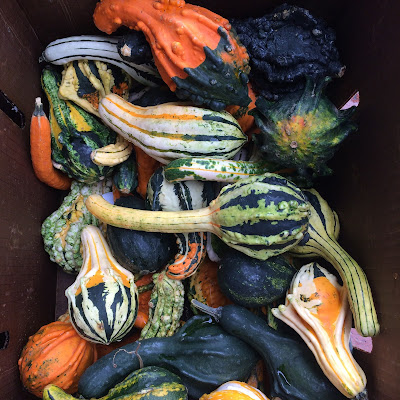
Pumpkins are a huge tradition around the fall or autumn time, and are often associated with harvest festival celebrations, Thanksgiving, and Halloween. But what do we know about pumpkins and where do these traditions come from? 🎃

Pumpkins are thought to have originated from Central America around 7,500 years ago, however they are now grown successfully all over the world and form a large part of autumn celebrations in North America and Europe.  They are technically a type of squash and can come in all different shapes, sizes and colours!  The most classically well-known orange pumpkins are actually called Connecticut Field Pumpkins or Harvest Moon pumpkins and these are usually used at Halloween because they are so good for carving.

Making Jack-o'-lanterns or carved pumpkins started in Ireland in 19th century where they carved faces out or turnips or mangel wurzels to ward off evil spirits.  This practice became part of Halloween celebrations where they were used to represent supernatural beings on the eve of All Hallows or All Saints and is now synonymous with Halloween wherever it is celebrated. 

Pumpkins also play a huge role in the American tradition of Thanksgiving.  The Pilgrims apparently ate pumpkins and squashes that were native to New England and so gradually they became added to the Thanksgiving meal either as a savoury dish such as mashed pumpkin, or a sweet dish in the form of pumpkin pie. 

A huge number of pumpkins are grown every year around the world.  Around 700,000 tonnes of pumpkins are produced in the US each fall, but the number grown in China far exceeds this with around 8.1 million tonnes harvested each year.  Sadly, many of these pumpkins are wasted as they are used for carving and decoration and then discarded into landfill.  We can make more sustainably choices however, if we try to choose varieties that are more edible so the flesh, seeds and skin are not wasted.  We can also make sure we compost any leftover pumpkin or put it out for birds, squirrels and foxes who may benefit from the extra food source at this time of year.  Roasting the seeds is another good option for making the most of the pumpkin's inner contents.  Finally, try to buy pumpkins from a local farm as this minimises the transport costs and emissions and supports local businesses.  And it's sure to be a fun day out too!

To find out more, click here to read about pumpkins and the issue of unsustainability.
To find out how to use your pumpkin once Halloween is over, click here for some ideas!
🎃

Saturday, 10 October 2020

Colours of the fall

Looking at the horizon now, I can see so many autumn colours on all the trees that surround our houses, parks and green spaces.  I am reminded of the rainbows of lockdown and how the bright colours were a symbol of hope in these uncertain days.  With another (sort-of!) of lockdown feeling imminent, it feels like the right time to take a moment to look at the colours and beauty around us and take ourselves into nature where it is calm, quiet and peaceful.  

I love nothing more than stepping out of the door and finding new woodland trails to explore in my local area.  Seeing the colours on the leaves turning shades of yellow, orange and red made me stop and think about how and why this happens. What is it that makes the leaves change colour and fall down, and why does it happen now?

Well it's all down to chemicals in the leaves called pigments. Chlorophyll is the most well-known pigment which makes the leaves a green colour. This helps the plant to make food using the sun's light. Another pigment is carotene which is a yellow colour, and anthocyanin which turns the leaves red and pink. 

The strength of these pigments is determined by different things.  When the nights start to get colder, the chlorophyll is destroyed by the colder temperatures and the leaf takes on a yellow colour.  If the weather stays dry, the sugars in the leaves become more concentrated and more anthocyanin is produced making the leaves turn red. Sunny days help the plant use up the remaining chlorophyll and produce sugars making it turn from green to red. 

As the days get shorter and darker, it signals to the tree to shed its leaves.  This is because there is not enough sunlight for the tree to keep producing energy and so the leaves are dropped and will be regrown in the spring. The shedded leaves fall to the ground and are decomposed by bacteria and fungi which releases nutrients ready to be taken up again. 

To find out more about the tree cycle, visit The Wildlife Trusts page on Autumn Leaves 🍁