Sunday, 25 October 2020

Pumpkins in the fall

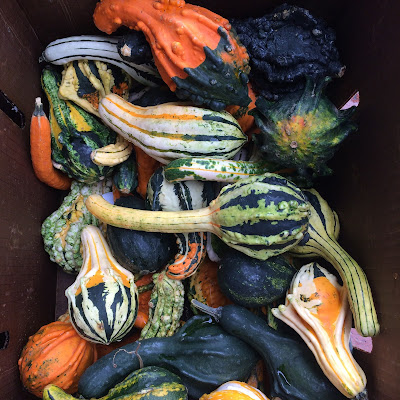
Pumpkins are a huge tradition around the fall or autumn time, and are often associated with harvest festival celebrations, Thanksgiving, and Halloween. But what do we know about pumpkins and where do these traditions come from? 🎃

Pumpkins are thought to have originated from Central America around 7,500 years ago, however they are now grown successfully all over the world and form a large part of autumn celebrations in North America and Europe.  They are technically a type of squash and can come in all different shapes, sizes and colours!  The most classically well-known orange pumpkins are actually called Connecticut Field Pumpkins or Harvest Moon pumpkins and these are usually used at Halloween because they are so good for carving.

Making Jack-o'-lanterns or carved pumpkins started in Ireland in 19th century where they carved faces out or turnips or mangel wurzels to ward off evil spirits.  This practice became part of Halloween celebrations where they were used to represent supernatural beings on the eve of All Hallows or All Saints and is now synonymous with Halloween wherever it is celebrated. 

Pumpkins also play a huge role in the American tradition of Thanksgiving.  The Pilgrims apparently ate pumpkins and squashes that were native to New England and so gradually they became added to the Thanksgiving meal either as a savoury dish such as mashed pumpkin, or a sweet dish in the form of pumpkin pie. 

A huge number of pumpkins are grown every year around the world.  Around 700,000 tonnes of pumpkins are produced in the US each fall, but the number grown in China far exceeds this with around 8.1 million tonnes harvested each year.  Sadly, many of these pumpkins are wasted as they are used for carving and decoration and then discarded into landfill.  We can make more sustainably choices however, if we try to choose varieties that are more edible so the flesh, seeds and skin are not wasted.  We can also make sure we compost any leftover pumpkin or put it out for birds, squirrels and foxes who may benefit from the extra food source at this time of year.  Roasting the seeds is another good option for making the most of the pumpkin's inner contents.  Finally, try to buy pumpkins from a local farm as this minimises the transport costs and emissions and supports local businesses.  And it's sure to be a fun day out too!

To find out more, click here to read about pumpkins and the issue of unsustainability.
To find out how to use your pumpkin once Halloween is over, click here for some ideas!
🎃
Sunday, 18 October 2020

Activity: Make a hedgehog home

This is the time of year when hedgehogs start to hibernate. Hedgehogs are sadly in decline in the UK with less than a million left due to a decline in their habitats. Making a home or shelter for hedgehogs will help them by providing them with a secure place to shelter, hibernate, or even raise little hoglets safely.

Hedgehogs go house-hunting in the autumn and so this is the ideal time of year to set one up.  To make a really simple hedgehog home, all you need is a large cardboard box.  Cut two side vents into the two walls of the box and a large entrance for the hedgehog to walk in.  Next, find a place suitable to put the hedgehog home.  A quiet part of your garden under thick vegetation is best. Somewhere behind a shed if you have one would be perfect!  Place the box south-facing if you can.  Finally, tear up some newspaper and place it inside to make a cosy and dry floor.  Add some straw on top if you have it.  If you box is not under vegetation, you might want to cover it with a plastic bag (leaving the vents and entrance open) and then place leaves and deadwood on top.  

You can also make a hedgehog house out of a more sturdy plastic container or even pieces of wood if you have them.  Click here to read instructions from the Wildlife Trusts.

Linking gardens together is also a great way of making areas more hedgehog friendly.  Did you know that hedgehogs can travel up to one mile every night?!  Ensure that you have small holes at the bottom of your fence that are free of leaves and twigs for hedgehogs to pass through.  See if you can get your whole street on board to help make a hedgehog highway! Click here to find out more from the Hedgehog Street campaign. 

Saturday, 10 October 2020

Colours of the fall

Looking at the horizon now, I can see so many autumn colours on all the trees that surround our houses, parks and green spaces.  I am reminded of the rainbows of lockdown and how the bright colours were a symbol of hope in these uncertain days.  With another (sort-of!) of lockdown feeling imminent, it feels like the right time to take a moment to look at the colours and beauty around us and take ourselves into nature where it is calm, quiet and peaceful.  

I love nothing more than stepping out of the door and finding new woodland trails to explore in my local area.  Seeing the colours on the leaves turning shades of yellow, orange and red made me stop and think about how and why this happens. What is it that makes the leaves change colour and fall down, and why does it happen now?

Well it's all down to chemicals in the leaves called pigments. Chlorophyll is the most well-known pigment which makes the leaves a green colour. This helps the plant to make food using the sun's light. Another pigment is carotene which is a yellow colour, and anthocyanin which turns the leaves red and pink. 

The strength of these pigments is determined by different things.  When the nights start to get colder, the chlorophyll is destroyed by the colder temperatures and the leaf takes on a yellow colour.  If the weather stays dry, the sugars in the leaves become more concentrated and more anthocyanin is produced making the leaves turn red. Sunny days help the plant use up the remaining chlorophyll and produce sugars making it turn from green to red. 

As the days get shorter and darker, it signals to the tree to shed its leaves.  This is because there is not enough sunlight for the tree to keep producing energy and so the leaves are dropped and will be regrown in the spring. The shedded leaves fall to the ground and are decomposed by bacteria and fungi which releases nutrients ready to be taken up again. 

To find out more about the tree cycle, visit The Wildlife Trusts page on Autumn Leaves 🍁

Sunday, 27 September 2020

Red Squirrel Awareness Week

This week is all about the Red Squirrel!

Red squirrels have become increasingly rare in the UK with only around 140,000 left in the wild.  The non-native American Grey squirrel is much more numerous (thought to be around 2.5million) and it is this squirrel that we more commonly see in our parks, gardens and woodlands.  Grey squirrels were only brought to the UK around 200 years ago but they have now spread far and wide and are endangering the populations of red squirrels.  

Red squirrels used to be found all over the UK up until the 1950s.  However, they are now most commonly found in areas such as Scotland, the Lake District and Northumberland where there is a lot of conifer woodland.  This is because this habitat is in decline due to climate change and so the red squirrels are having to retreat even further north.   

So what is being done?  The Wildlife Trusts are working hard to help save the red squirrels from extinction.  They are actively involved in managing their habitat to make sure they have enough areas in which to live, eat and breed successfully.  They closely monitor squirrel populations and control grey squirrel numbers in areas where red squirrels are significantly in decline.  Through education and awareness projects, it is hoped that red squirrel numbers may start to rise again and thrive in all parts of the UK.

To find out more, click the links below:

Tuesday, 22 September 2020

The Autumn Equinox

Today marks the official start of autumn in the UK  🍁

This is when the days start to become noticeably shorter and we get cooler temperatures taking over our weather.   The term equinox comes from latin meaning 'equal light'. At this time of year, the sun is rising at around 7am and setting around 7pm, meaning the days have approximately equal day light and night time at the moment.  From now on however, the days will continue to get shorter until we reach the winter solstice in December when the days will begin to lengthen again.  

Some animals are preparing to hunker down and survive the harsher conditions that winter brings, whilst plants and flowers are finishing their final blooms and putting their energy into making seeds for the next spring.  Here are some of the changes that you may start to notice:

🍂 Leaves change colour to wonderful yellows, oranges and reds and start to fall from the trees
🍂 Nuts, seeds and berries are growing in abundance and falling from the trees too - animals like squirrels take advantage of this food source before the cold winter arrives!
🍂 Large groups of birds will fly south in search of warmer weather
🍂 Mornings get misty as the night temperatures drop a lot colder over night
🍂 Birds such as starlings appear to dance in the sky as they swarm together to keep warm
🍂 Fungi comes alive as it feeds on the dead and decaying leaf matter 

To find out more about autumn, click on the links below:
🍁 The BBC 

Saturday, 12 September 2020

Activity: What to sow in September

As we slowly crawl towards the end of the summer we may feel sad as the flowers start to fade and the crisp sun-dried leaves begin to fall to the ground.  It's a good time to cut back any dead-heads, dried grasses and faded blooms, but we can also begin to think about what wonderful fruit and vegetables we may want for the year ahead!

Here are some ideas for what to sow in September:
🌽 Leafy veg - sowing seeds for things like cabbages and spinach is best done in September though they may need some protection over winter
🌽 Broad beans and peas - these are hardy plants that will establish over winter and be ready to harvest next spring
🌽 Radishes - these can be sown and grow quickly ready for a crop in a few weeks!
🌽 Onions and garlic - isn't it great to grow your own so that they're right there for when you need them?... planting in autumn means you will have a crop ready to harvest from early next year
🌽 Herbs - things like coriander, parsley and rocket grow well and are hardy to the colder temperatures

Did you know that September is also the month for growing food organically? This means growing food without toxic pesticides that are harmful to wildlife and require a lot of energy to manufacture. Growing your own veg is the perfect way to stay organic and avoid buying into the large-scale farmed supermarket produce. 

To find out more about what to grow, visit the Gardener's World website. 
To read more about Organic September, visit the Soil Association website. 

Sunday, 6 September 2020

National Read a Book Day!

Today is National Read a Book Day!  It is a day to remind us of the simple joy of reading a book and escaping into a another world for a short time.  Whether you love to read story books, poems, travel books, or the classics, we can all share in the experience of curling up with a good read and National Read a Book Day is the perfect day to get back into that habit!

Reading is a fantastic hobby with so many benefits.  It has been shown to help your memory, develop your writing skills and vocabulary, and also improve your analytical skills and concentration.  Studies have also shown it aids relaxation and has a calming effect.  I know so many people who use reading as a good way to fall off to sleep at night!

If you don't usually read, why not give it a try today.  Choose a book that has perhaps been sitting on your shelf for a long time that you've never picked up and find a cosy corner to sit in to begin reading. If you have children, why not read aloud or make story time a part of the bedtime routine.  Non-fiction and travel books can be a good way into reading if you've fallen out of the habit.  Treating yourself to a newspaper or magazine can also be a great way to spend half an hour away from phone and TV screens and other distractions.  Or if you're lucky enough to have a Kindle or similar, why not browse the whole library of books out there and find something new to enjoy! 📚